
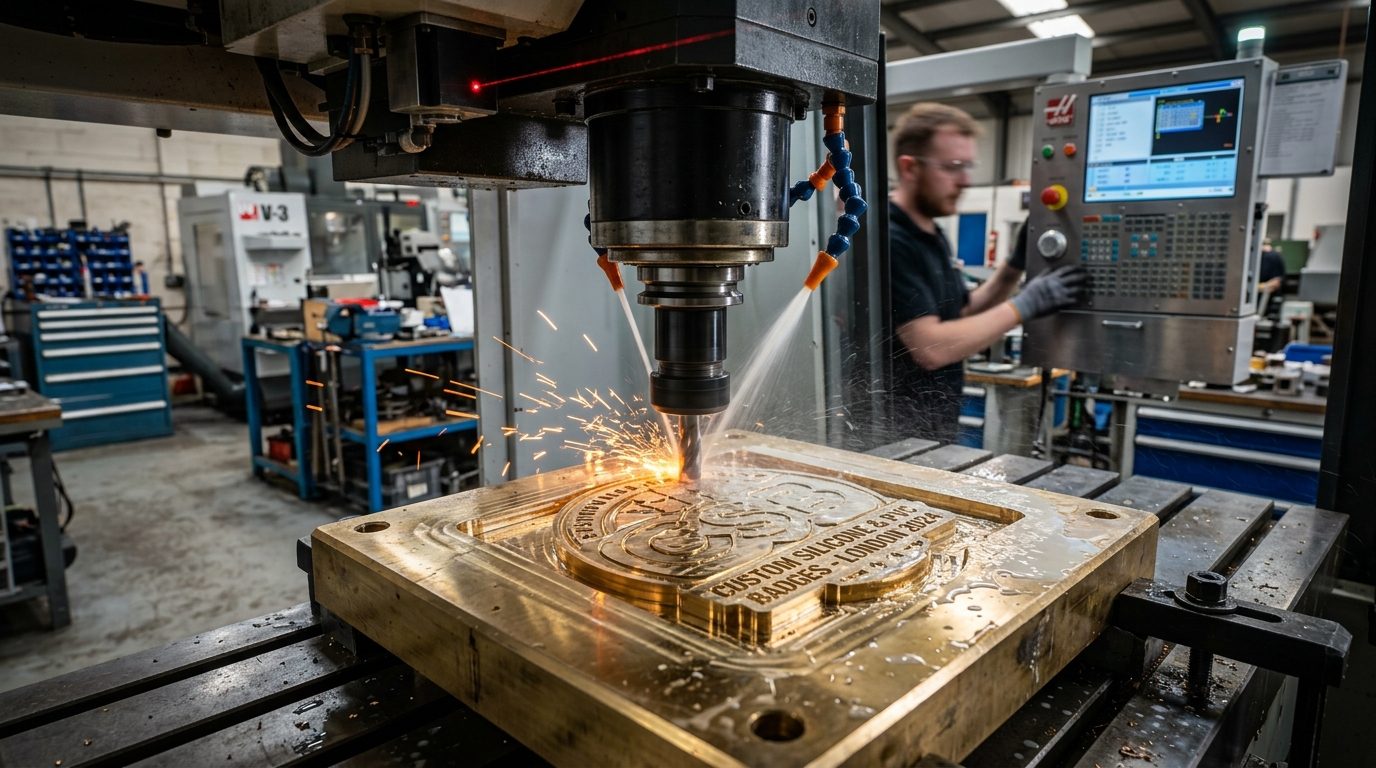
Figure 1.0: High-speed CNC copper mold machining under continuous cooling fluid spray at Naike Gifts Jinjiang tooling workshop.
- Prototype Mold Cost: Single-cavity copper sample tooling ranges between $65 and $140 with a rapid 3-to-5 business day fabrication timeline.
- Mass Production Tooling: Multi-cavity (8 to 16 cavity) hardened tooling runs $250 to $650, capable of producing 5,000 to 15,000 pieces per day.
- 100% Mold Fee Credit: Naike Gifts credits back the entire tooling expense once client order volumes reach agreed thresholds (typically 5,000 units).
- Client Tooling Ownership: Tooling remains dedicated exclusively to the purchasing client, stored in climate-controlled archives with zero third-party reuse.
One of the most persistent misconceptions among corporate merchandising directors is that custom tooling is prohibitively expensive or risky. In modern direct-source manufacturing, CNC automation has democratized bespoke tooling, allowing brands to launch fully custom-sculptured promotional collectibles with nominal upfront investments that amortize to negligible pennies per piece.
1.0 Tooling Metallurgy: Copper vs Hardened Steel
For elastomeric soft PVC and silicone micro-injection, copper alloy molds are the industry gold standard. Copper features exceptional thermal conductivity (390 W/m·K), ensuring that complex multi-level color channels heat and cool uniformly on baking conveyors without warping. For ultra-high volume orders (50,000+ pcs) or die-cast zinc alloys, hardened NAK80 or S136 stainless steel dies are utilized to withstand high hydraulic pressures across 500,000 cycles.
2.0 Cavity Count vs Piece-Price Economics
A single-cavity sample mold is optimized for rapid physical proofing and small pilot runs of 500 pieces. For volume orders of 10,000+ units, tooling engineers design 16-cavity or 24-cavity progressive molds. While the upfront tooling cost increases from $85 to $350, the per-unit cycle time drops from 45 seconds to 4 seconds, slashing the finished unit price by 35% to 50%.
3.0 The Mathematical Breakdown of Mold Amortization
Consider a standard custom shoe charm drop of 5,000 units with a $250 multi-cavity production mold. The amortized tooling charge is: $250 / 5,000 = $0.05 per unit. Because Naike Gifts refunds the $250 once the 5,000 milestone is met, the actual effective tooling cost is exactly $0.00.
4.0 Tooling Longevity & Zero-Fee Maintenance
Client molds are cataloged in automated climate-controlled tooling vaults. Naike Gifts guarantees lifetime mold maintenance—including ultrasonic cavity cleaning and anti-corrosion oiling—with zero recurrent storage or re-tooling fees on re-orders.
Mold Tooling Specification & Cost Matrix
| Tooling Classification | Cavity Configuration | Typical Tooling Cost | Production Lead Time | Volume Threshold for 100% Refund |
|---|---|---|---|---|
| Single-Cavity Prototype Copper | 1 Cavity | $65 – $120 | 3 – 5 Days | Refunded at 3,000 pcs |
| Standard Production Copper Mold | 4 – 8 Cavities | $180 – $320 | 5 – 7 Days | Refunded at 5,000 pcs |
| High-Speed Multi-Cavity Steel | 16 – 24 Cavities | $450 – $750 | 8 – 12 Days | Refunded at 10,000 pcs |
| Zinc Alloy Die-Cast Steel Die | 2 – 4 Cavities | $280 – $650 | 10 – 14 Days | Refunded at 10,000 pcs |
Common Industry Misconceptions Debunked
❌ Myth 1: 'Factories will reuse my custom molds for other clients'
✔ Engineering Reality: At Naike Gifts, an explicit Tooling Ownership & Non-Disclosure Agreement guarantees that molds remain proprietary client IP, strictly forbidden from unauthorized production.
❌ Myth 2: 'A design modification means scrapping the entire mold'
✔ Engineering Reality: Minor typographic edits or base thickness modifications can frequently be re-machined directly onto existing copper plates via micro-milling, saving up to 70% in revision costs.
Engineering Case Study & Production Outcome
Project Background: An international retail brand required custom limited-edition key fobs across 6 different character variants for a holiday launch.
Root Cause Engineering Audit: The brand anticipated paying 6 separate master mold charges totaling over $3,000, straining campaign marketing budgets.
Technical Corrective Actions Implemented:
- Modular Master Base: Engineered a universal quick-change master steel frame accommodating interchangeable copper cavity inserts.
- Shared Tooling Architecture: Reduced per-variant mold costs from $500 to $95 per character insert.
- Ganged Production Runs: Executed unified polymer slurry dispensing across all 6 characters in synchronized batches.
Final Production Outcome: Saved the client $2,430 in tooling fees while shortening delivery timeline by 9 business days.
Tooling Procurement Checklist for Brand Managers
- Verify digital 3D CAD approval workflow (should be under 12 hours).
- Ensure contractual confirmation of tooling ownership and exclusivity.
- Confirm physical sample photos and pre-shipment video proofs before mass molding begins.
- Request written confirmation of volume mold fee refund thresholds.
Need Physical Samples or Tooling DFM Feasibility Analysis?
Naike Gifts engineering facility provides physical sample packs and factory evaluations within 24 hours.
Frequently Asked Questions (FAQ)
How long do custom copper molds last?
Under proper factory maintenance, precision copper molds easily sustain 50,000 to 100,000 injection cycles with zero loss of edge sharpness.
Can I inspect physical pre-production samples before mass run?
Yes. Every production project requires physical golden sample approval or high-definition macro video signoff prior to mass line startup.