
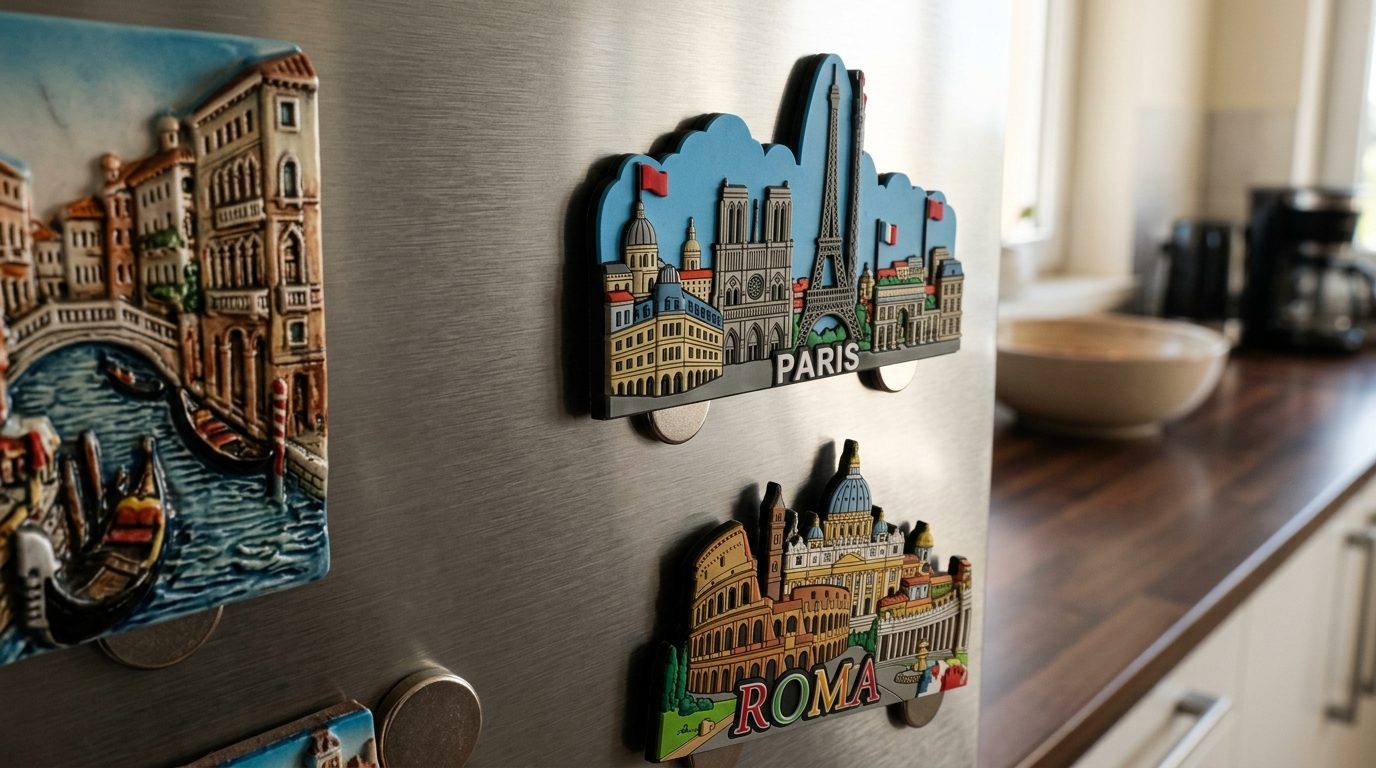
Figure 1.0: Architectural 3D souvenir magnets on stainless steel refrigerator door, exhibiting multi-tier relief elevations.
- Architectural Fidelity: 4 to 6 stepped elevation planes carved with 0.05mm CNC precision, capturing delicate cathedral arches, skyline towers, and brand mascots.
- Magnetic Holding Power: 1.5mm high-density anisotropic magnetic rubber yielding 650+ Gauss, holding 8 to 12 sheets of paper without slipping.
- Non-Toxic Formulation: Bio-citrate plasticizer ensures odor-free indoor display meeting California Prop 65 and European REACH limits.
- Tooling Efficiency: Single-cavity prototype copper molds fabricated in 3 to 5 days from standard vector artwork or landmark photographs.
Souvenir fridge magnets represent the bedrock of destination tourism, cultural institutions, and commemorative retail collections. Contemporary consumers demand dimensional architectural depth, vibrant fade-resistant coloration, and substantial magnetic holding power that prevents unsightly vertical slippage.
1.0 Multi-Tier Micro-Relief Tooling
Standard flat printed magnets lack emotional resonance. Naike Gifts engineers stepped 3D reliefs by carving multi-level copper mold cavities at 24,000 RPM. A typical design incorporates a 0.8mm textured background base, 1.5mm middle landscape structures, and 2.5mm to 3.5mm foreground hero elements, producing an authentic architectural diorama.
2.0 Magnetic Flux Density: Anisotropic vs Isotropic
Low-grade magnets utilize recycled isotropic rubber with flux densities below 250 Gauss, failing to hold even a single grocery receipt. Naike Gifts mandates 1.5mm anisotropic barium-ferrite magnetic rubber (650–750 Gauss) laminated with moisture-proof adhesive, or twin recessed N35 neodymium disc magnets for heavy metal fobs.
3.0 Automated Multi-Needle Color Infill
Computerized 12-needle pneumatic dispensers precisely inject polymer pigments into micro-channels measuring 0.35mm wide. High-temperature conveyor curing vulcanizes each color sequentially, ensuring clean borders and zero inter-color bleeding.
4.0 Gift Card & Pegboard Merchandising
Destination gift shops require retail-ready presentation. Custom magnets are paired with 400 GSM foil-stamped backer cards with Euro-slots, or luxury kraft boxes suitable for high-end boutique display.
3D Souvenir Magnet Technical Specifications
| Parameter | Standard Grade Magnet | Naike Gifts 3D Architectural Magnet | Advantage |
|---|---|---|---|
| Relief Levels | Flat 2D (1 Level) | 3D Multi-Tier (4–6 Levels) | True architectural depth |
| Magnetic Flux | 220–280 Gauss (Isotropic) | 650–750 Gauss (Anisotropic) | Holds 10+ paper sheets |
| Color Separation | Coarse Silk Print | 0.05mm Micro-Injection | Zero pigment bleeding |
| Substrate Safety | Recycled PVC with DOP | Medical-Grade ATBC-PVC | 100% Phthalate-free |
| UV Fading Life | Fades in 6 months | 5+ years indoor lightfastness | Collector-grade longevity |
Common Industry Misconceptions Debunked
❌ Myth 1: 'All fridge magnets will slide down under their own weight'
✔ Engineering Reality: Vertical slippage occurs solely when vendors use cheap isotropic sheet rubber. Anisotropic magnetic sheeting provides 2.5x higher shear resistance.
❌ Myth 2: 'You must provide 3D CAD files to order 3D magnets'
✔ Engineering Reality: Naike Gifts engineering team converts standard 2D vector files or high-res photographs into multi-tier 3D mold tooling within 12 hours at no extra charge.
Engineering Case Study & Production Outcome
Project Background: A European national museum store ordered 25,000 units of custom 3D architectural cathedral magnets across 3 historical city designs.
Root Cause Engineering Audit: Prior trading supplier delivered magnets with warped backing rubber that curled and dropped off display racks.
Technical Corrective Actions Implemented:
- Substrate Correction: Substituted standard PVC with low-shrinkage ATBC compounding.
- Tooling Re-engineering: Carved 5 distinct architectural depth levels with 0.12mm spire towers.
- Anisotropic Lamination: Applied 1.5mm high-adhesion anisotropic magnetic backing under hydraulic press.
Final Production Outcome: Achieved 100% flat adhesion, zero customer returns across 25,000 pcs, and an immediate repeat order of 50,000 units.
Buyer Sourcing Checklist for 3D Magnets
- Verify minimum 600 Gauss flux density to guarantee anti-slip vertical hold.
- Inspect micro-groove depth (minimum 0.3mm) to prevent color bleeding between adjacent landmarks.
- Ensure backing rubber is die-cut 0.5mm smaller than the front emblem to prevent exposed edges.
- Specify UV-stable pigment compounding to prevent yellowing under gift shop spotlights.
Need Physical Samples or Tooling DFM Feasibility Analysis?
Naike Gifts engineering facility provides physical sample packs and factory evaluations within 24 hours.
Frequently Asked Questions (FAQ)
What is the typical mold fee for custom 3D souvenir magnets?
Single-cavity sample tooling costs between $85 and $140 and is 100% refundable upon 5,000 pcs total volume.
Can magnets feature glow-in-the-dark or glitter effects?
Yes, phosphorescent glow pigments and metallic glitter flakes can be blended directly into specific relief areas.