
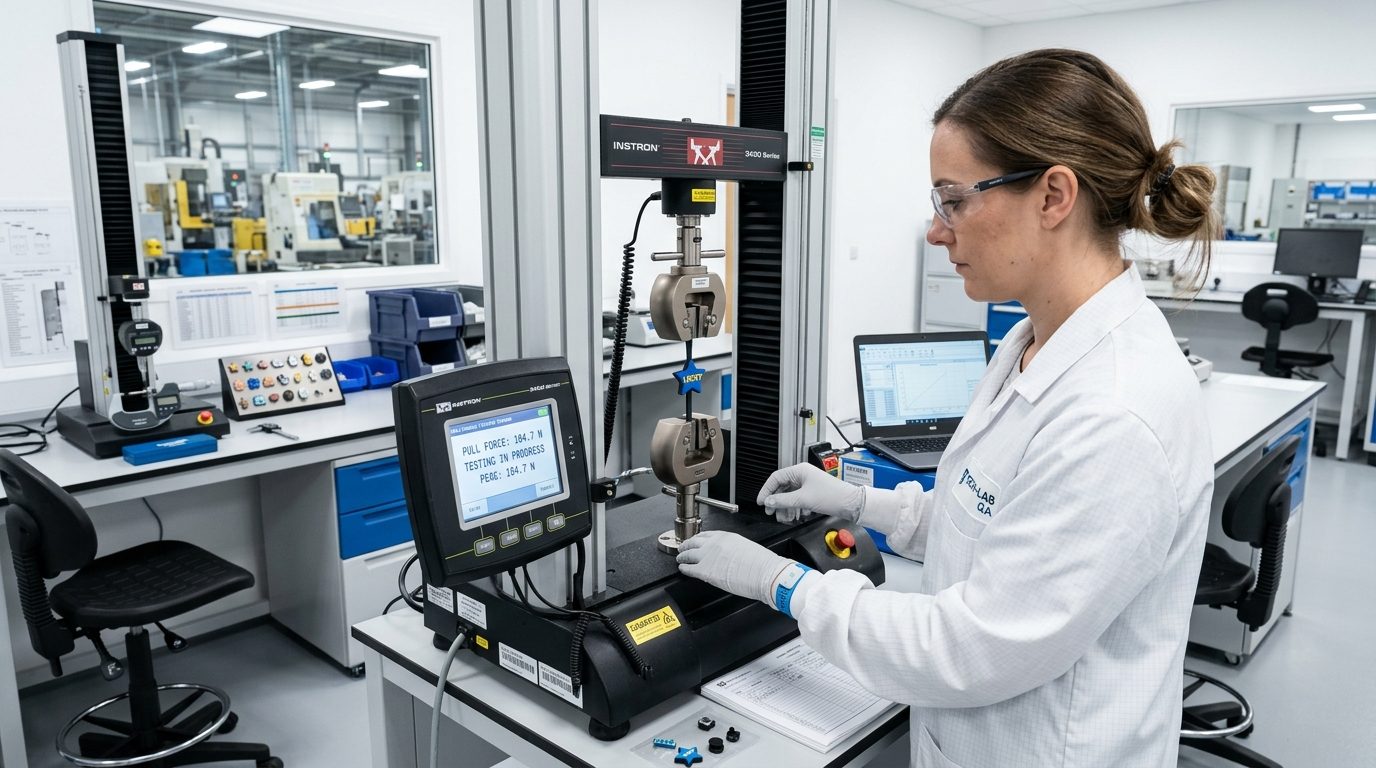
Figure 1.0: Calibrated tensile testing machine applying continuous 16 CFR pull force to accessory button components in Naike Gifts QA Laboratory.
- Statutory Standard: 16 CFR 1500.51 tension test benchmarks mandate that small component attachments must resist at least 15.0 lbs (66.7 N).
- Thermal Co-Molding Superiority: One-step vulcanization mechanically captures the POM button inside the cured polymer, reaching 18.5 to 24.0 lbs pull resistance.
- Adhesive Failure Mechanics: Chemical glues experience brittle failure under temperature cycling, moisture, and everyday footwear flexing.
- 100% Inline Calibration: Calibrated pneumatic pull gauges test production samples every 50 pieces on the assembly line.
In promotional accessories designed for apparel, footwear, or bags, mechanical attachment integrity is the ultimate line of defense against consumer liability. A detached charm button, badge pin, or keychain clip transforms an attractive promotional keepsake into a dangerous small parts choking hazard.
1.0 Small Parts Choking Hazards & Corporate Liability
Under international consumer protection regulations, any detached component that fits within a 1.25-inch small parts test cylinder is classified as a severe choking hazard. Product safety commissions in the US, EU, and Australia enforce mandatory public recalls for brands failing tension tests.
2.0 Adhesive Bonding vs Thermal Co-Molding
Budget manufacturers manually assemble shoe charms and badges by dabbing cyanoacrylate glue between a smooth pre-molded button and the back of a charm. Under casual wear, shear forces cause adhesive micro-fractures, leading to sudden button detachment. Naike Gifts employs one-step thermal co-molding: the undercut button base is loaded directly into the tooling mold, where molten ATBC-PVC flows around the retention flange, solidifying into a single molecular unit.
3.0 Laboratory Pull-Testing Operating Protocol
On calibrated digital tensile machines, sample charms undergo continuous perpendicular tensile pulling at 10 mm/min until failure. While the statutory pass mark is 15.0 lbs (66.7 N), Naike Gifts co-molded units consistently sustain 18.5 to 24.2 lbs (82 to 107 N) before tensile elongation begins.
4.0 Inline Sampling & Quality Verification
During mass production, quality control technicians test 1 piece out of every 50 units on benchtop pneumatic pull gauges. Any failure immediately triggers an automated line pause and cavity audit.
Attachment Technology Comparison Table
| Assembly Technology | Mechanical Holding Force | Failure Mode | Temperature Resistance | Risk Rating |
|---|---|---|---|---|
| Manual Cyanoacrylate Glue | 6.5 – 11.0 lbs (Fails 16 CFR) | Brittle adhesive snap | Degrades above 45°C | HIGH (Recall Risk) |
| Solvent Chemical Welding | 11.0 – 14.5 lbs (Borderline) | Interfacial peeling | Moisture sensitive | MODERATE RISK |
| Ultrasonic Plastic Welding | 15.5 – 17.5 lbs (Compliant) | Weld line shear | Stable -10°C to +60°C | LOW RISK |
| Naike Gifts Thermal Co-Molding | 18.5 – 24.2 lbs (Superior) | Base rubber elongation | Stable -20°C to +80°C | ZERO RISK (Certified) |
Common Industry Misconceptions Debunked
❌ Myth 1: 'A stronger glue can solve button detachment'
✔ Engineering Reality: No chemical adhesive can compensate for the smooth, low-surface-energy surface of POM buttons. Only mechanical undercut interlocking delivers permanent retention.
❌ Myth 2: 'Testing 1 sample per order is sufficient'
✔ Engineering Reality: Tensile strength fluctuates with mold temperature and curing dwell times. Systematic inline sampling every 50 pieces is essential to guarantee 100% batch reliability.
Engineering Case Study & Production Outcome
Project Background: A fast-fashion retail chain faced a potential recall when 50,000 shoe charms from another vendor exhibited loose buttons.
Root Cause Engineering Audit: The prior vendor used manual gluing with cold room temperatures, resulting in incomplete adhesive curing.
Technical Corrective Actions Implemented:
- Emergency Retooling: Naike Gifts designed a replacement 16-cavity co-molding tool within 72 hours.
- POM Undercut Engineering: Specified custom POM backing posts with 1.2mm radial retention grooves.
- 100% Pull Verification: Tested every batch on pneumatic tensile rigs recording digital load curves.
Final Production Outcome: Delivered 50,000 compliant units passing third-party Intertek 18.5-lb pull tests on first submission.
Quality Engineer Pull-Testing Checklist
- Verify tension test is conducted with continuous load applied for at least 10 seconds.
- Ensure backing post features mechanical retention undercuts rather than a smooth shaft.
- Review factory daily tensile test logbooks for the specific production lot.
- Confirm packaging carries appropriate small parts age grading.
Need Physical Samples or Tooling DFM Feasibility Analysis?
Naike Gifts engineering facility provides physical sample packs and factory evaluations within 24 hours.
Frequently Asked Questions (FAQ)
What happens if a charm button fails the 15-lb test?
If any sampled unit fails, the entire sub-lot of 50 pieces is quarantined and destroyed, and the mold cavity is audited.
Can we receive a factory certificate of pull test with our order?
Yes. Every production shipment includes a signed Quality Inspection Certificate documenting measured tensile force readings.